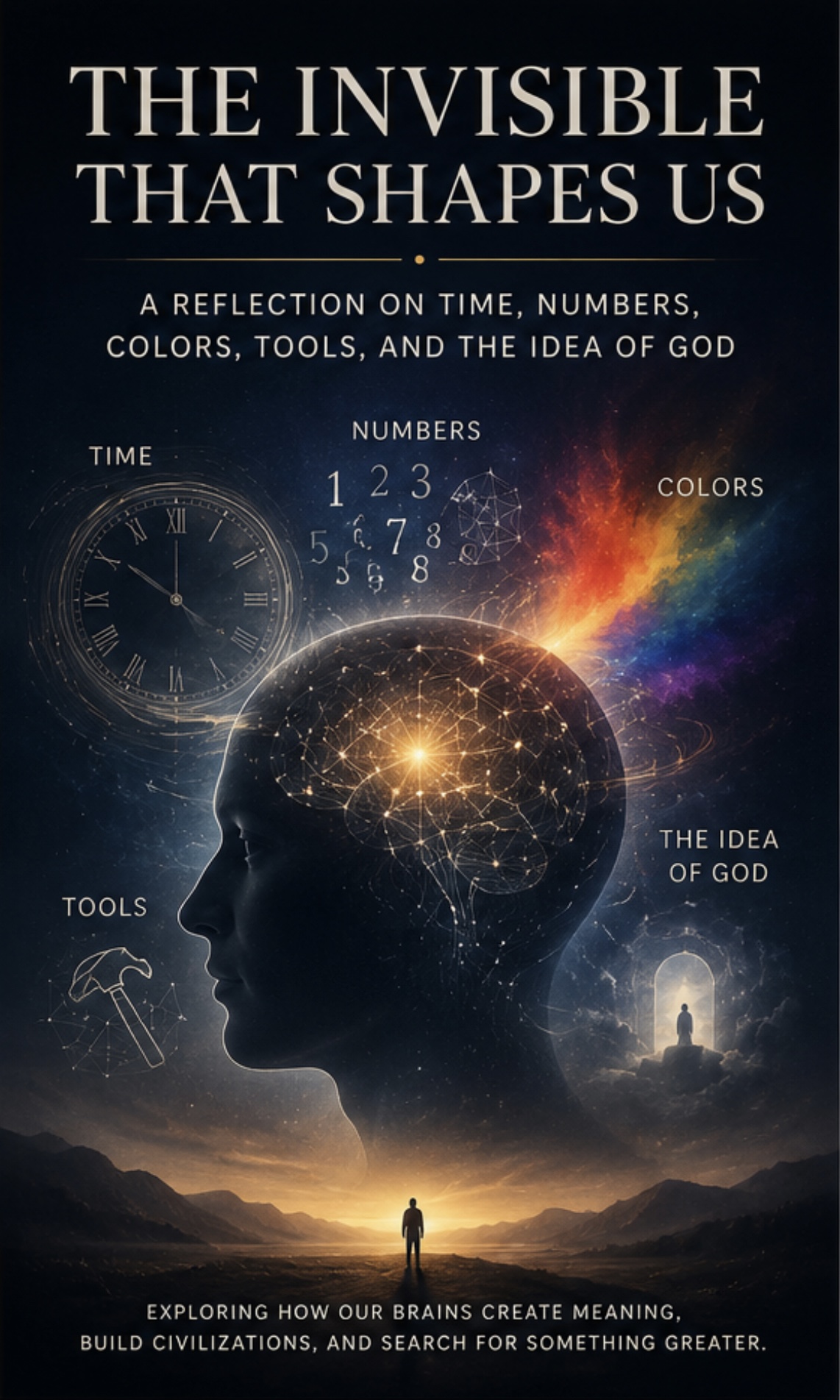
Before we discuss God, we must first ask a simpler question: How does the human mind deal with things it cannot touch? There are things we experience every day that have no physical form. We cannot hold them, weigh them, or place them on a table, yet we live as though they are unquestionably real.
Time, numbers, colors, language, justice, beauty, love, and even money all belong to this strange category. They exist not as ordinary physical objects, but as ideas, experiences, and systems through which the human mind organizes reality.
The Architecture of the Invisible
A second is invisible. The number three has no physical shape. The color red is not a substance that exists independently inside an object. Yet no one doubts that these concepts are useful and meaningful.
When we say “three apples,” we are not touching the number three. We are touching apples while using an abstract mental idea to describe quantity. The objects are physical, but the number used to organize them belongs to the world of thought.
Time behaves in a similar way. No one has ever seen time itself. We observe change: the movement of the sun, the beating of the heart, the growth of a child, and the aging of the body. From these changes, we created clocks, calendars, schedules, and units of measurement.
Time may describe something real about change, but the way we divide it into seconds, hours, weeks, and years is a human system. It is a framework through which the mind makes movement and change manageable.
Colors reveal an even deeper mystery. Objects do not contain redness or blueness as we consciously experience them. Physical surfaces reflect different wavelengths of light, and the brain transforms those signals into the experience we call color.
The world outside provides the stimulus, but the experience is completed inside the mind.
The Brain as a Meaning-Making Organ
The human brain does not record the world like a perfectly neutral camera. It selects, simplifies, compares, predicts, and interprets. It searches for patterns and builds connections between events.
Without this ability, we could not develop mathematics, language, music, science, law, or civilization. Our survival depends not only on seeing what is physically present, but also on creating mental models of what has happened, what may happen, and what our actions might produce.
A child first understands numbers through objects: one toy, two hands, three people. Gradually, the invisible concept becomes so familiar that it feels almost as concrete as the objects it describes.
The same process happens with justice. No one has photographed justice itself. A courtroom cannot place justice inside a container. Justice exists through principles, judgments, shared expectations, and human agreements.
Money also depends upon an invisible structure of trust. A piece of paper or a number displayed inside a banking application has power because societies agree that it represents value. Entire economies operate through shared confidence in an abstract system.
The Invisible as a Collection of Tools
Perhaps the best way to understand these invisible concepts is to see them as tools rather than objects. The human brain evolved not merely to observe reality, but to survive within it. To do that, it developed powerful cognitive tools: time to organize change, numbers to measure quantity, language to communicate ideas, money to coordinate exchange, and morality to guide social behavior.
These are not ordinary physical objects waiting to be picked up from the ground. They are mental instruments that help us navigate a world far more complex than our senses alone could understand. Their value lies not in their tangibility, but in what they allow us to accomplish.
A hammer extends the strength of the hand. A telescope extends the reach of the eye. In the same way, numbers, language, time, and symbols extend the power of the mind.
They allow us to remember what is absent, measure what is changing, imagine what does not yet exist, cooperate with strangers, transmit knowledge across generations, and build things that no individual human being could create alone.
These invisible tools compress overwhelming complexity into patterns the mind can use. Whether they are created, discovered, or some combination of both, they help turn a confusing universe into a world that human beings can navigate.
The Question of God
Perhaps this helps explain why the idea of God feels natural to so many human beings. God, like time, cannot be held as a physical object. Like numbers, God may function as an organizing principle. Like justice, God can represent a standard beyond the individual. Like money and social institutions, belief can gain enormous power when it is shared by communities.
The idea of God may become a mental framework through which people organize mystery, morality, suffering, hope, death, purpose, and the unknown.
This observation does not automatically prove that God is only a human invention. It also does not prove that God exists outside the mind. It simply reveals that the brain already has a powerful ability to create and use invisible frameworks.
The difficult question is whether the idea of God is another tool made by the mind, or whether the mind is using that idea to recognize something that genuinely exists beyond it.
These possibilities should not be confused. An idea can be psychologically useful without being objectively true. At the same time, something may exist independently of us even when our minds can only understand it through symbols, stories, and incomplete concepts.
Utility Is Not the Same as Truth
Numbers are useful. Time is useful. Money is useful. Justice is useful. The idea of God can also be useful. But usefulness alone cannot determine what kind of reality each concept possesses.
Some concepts describe patterns found in nature. Some arise from perception. Some are collective agreements. Some are emotional experiences. Some are symbolic explanations. Others may point toward realities that exist independently of human thought.
Wisdom requires us to ask not only whether an idea helps us, but also what evidence supports it, how it was formed, what category of existence it belongs to, and what happens when people mistake a mental tool for an unquestionable external fact.
Why the Mind Believes
The brain dislikes uncertainty. When information is incomplete, it fills the empty spaces. When causes are hidden, it searches for an explanation. When events seem random, it tries to connect them into a meaningful story.
This tendency has produced both humanity’s greatest achievements and its greatest misconceptions. Science emerged because we searched for explanations. Religion emerged because we searched for meaning. Philosophy emerged because we questioned both.
The same brain that discovers patterns can also imagine patterns that are not there. The same mind that creates useful tools can also become imprisoned by them. A concept designed to help us understand reality can eventually be mistaken for reality itself.
Therefore, our invisible tools must remain open to examination. They should help the mind think, not prevent it from thinking.
Reflection
Perhaps the greatest mystery is not only whether God exists. The deeper mystery is why the human mind is capable of imagining, creating, and living through realities that cannot be touched.
This ability allows us to create mathematics, music, language, morality, law, science, culture, and civilization. It allows us to cooperate with people we have never met, remember people who are no longer present, and build futures that exist first only in imagination.
But this gift also demands responsibility. We must learn to distinguish between what exists physically, what emerges through perception, what society collectively agrees upon, what the mind creates for survival, and what may exist beyond our ability to verify.
The invisible is not automatically unreal. But neither is every invisible idea automatically true.
Wisdom begins when we recognize that the human mind is both a discoverer and a creator of meaning. Whether God is another tool constructed by this mind, or a reality the mind is attempting to comprehend, remains one of humanity’s deepest questions. The instrument asking the question is the same instrument that creates time, numbers, colors, language, and every invisible framework through which we understand existence.
Discussion
Share your reflection
What do you think? Are time, numbers, colors, and God discoveries, mental tools, or a combination of both?