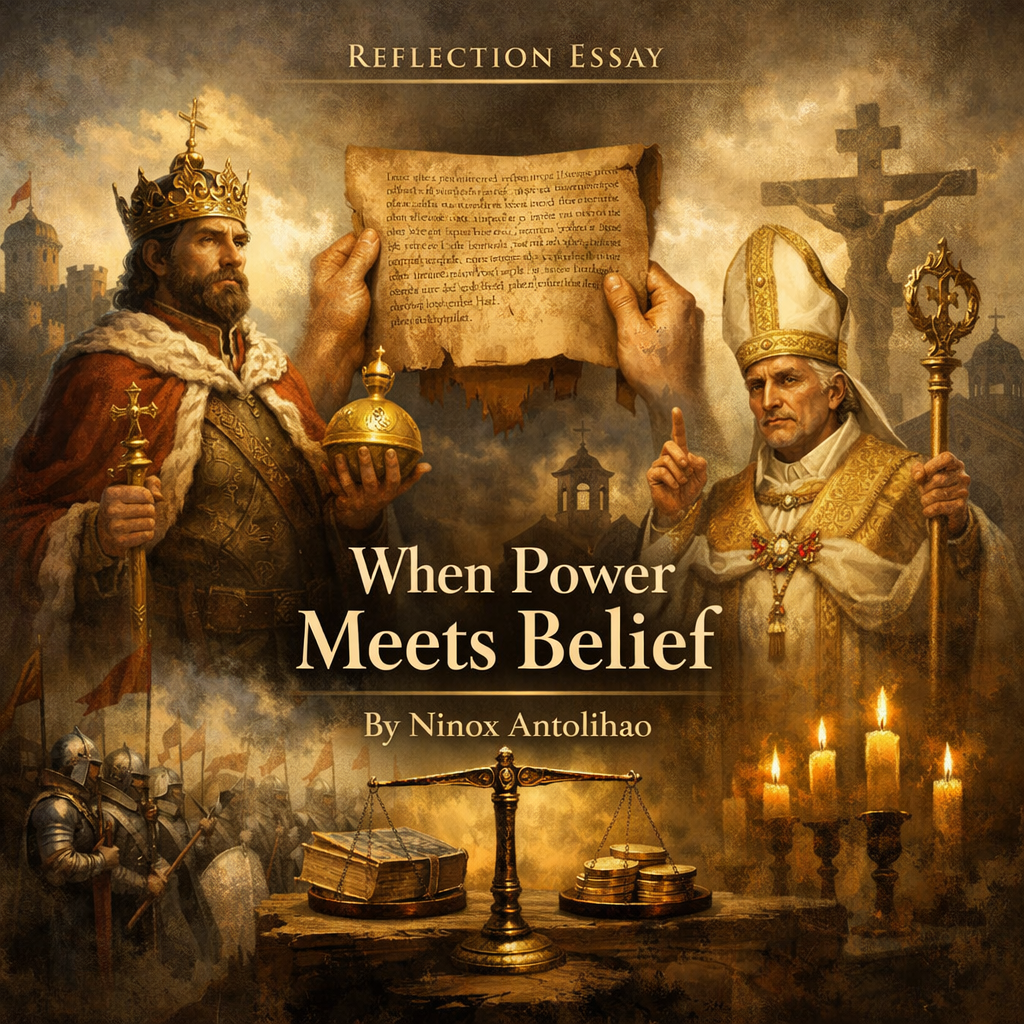
When Power Meets Belief
There was once a man named Jesus.
He gathered followers, challenged ideas, and was eventually executed by the ruling power of his time--the Roman Empire. After his death, his followers did not stop but continued teaching, forming small communities, and spreading his message across different places.
At that time, they had no power, no protection, and no system backing them.
-- ❖ --
For a long time, the Roman Empire even tried to suppress them. burned the books, kill those who threatens their structure. and thats why Jesus was crucified because he challenged them.
But over time, something changed.
The empire that initially persecuted jesus eventually co-opted and institutionalized it. Christianity went from being a small, scattered belief to becoming a centralized system of the roman empire.
And this naturally raises a question: When a powerful system adopts a belief, does it preserve it… or reshape it?
-- ❖ --
There is reason to question on what had really happened. There were already communities, teachings, and writings circulating.
On the other side, once it became part of an organized system, beliefs were defined and standardized, some writings were accepted, and others were rejected or lost.
The suppression and control of literature that contradicted Roman Catholic teachings—particularly during the Counter-Reformation—was a highly organized and bureaucratic effort. The Church utilized a combination of legal frameworks, censorship lists, and physical destruction to maintain doctrinal purity.
Not everything survived.
And this leads to another question: What we have today may not be the full picture, but what was selected and preserved.
-- ❖ --
There are also details that raise further questions.
Some elements of the story seem similar to older cultural ideas. Some traditions appear to align with the pagans like the Pontifex Maximus.
This does not automatically mean they were copied or inserted. But it does show that belief does not exist in isolation.
It develops within a cultural environment. Ideas move through people, language, power, and time.
-- ❖ --
So we are left between two possibilities. That the story began authentically and was later shaped, or that parts of it were influenced and adjusted along the way. The most possible thing may not sit entirely on one side.
History is rarely that clean.
Ideas can begin genuinely, spread through people, and later be organized, structured, and influenced by power.
That does not automatically make the beginning false.
And it does not guarantee that everything remained untouched.
-- ❖ --
many Christian teachings or traditions "sound" pagan is often due to syncretism—the process where different beliefs and cultures blend over time.
When Christianity began spreading through the Roman Empire and eventually Europe, it didn't exist in a vacuum; it was surrounded by centuries of Greek, Roman, and Germanic traditions.
Christmas:
The Bible doesn't give a specific date for Jesus' birth. December 25th coincided with the Roman festival of Sol Invictus (the Unconquered Sun) and the winter solstice. It was easier to celebrate the "Son of God" when people were already celebrating the "Sun."
Easter:
The name "Easter" likely comes from Eostre, a Germanic goddess of spring. Symbols like eggs and rabbits were ancient symbols of fertility and new life that were eventually linked to the Resurrection.
Paganism was often focused on the cycles of nature (seasons, harvests, and the stars).
Christianity reframed these symbols to focus on a linear historical event (the life of Jesus).
So, while the "shell" of the teaching—the date, the symbol, or the ritual—might have pagan roots, the "core" was changed to fit a new message. It’s a bit like a new software update running on old hardware.
So the question is no longer simply, "Is it true or not?"
But something more grounded: What part remained original, what part was shaped, and what part is no longer visible?
To hold this question without rushing to an answer is not confusion. It is awareness.
Because sometimes, the most honest position is not certainty, but clarity about what we know, what we do not, and what may lie in between.
This reflection does not claim to replace belief, but invites it to be examined--not to destroy truth, but to seek it more honestly.
Comments