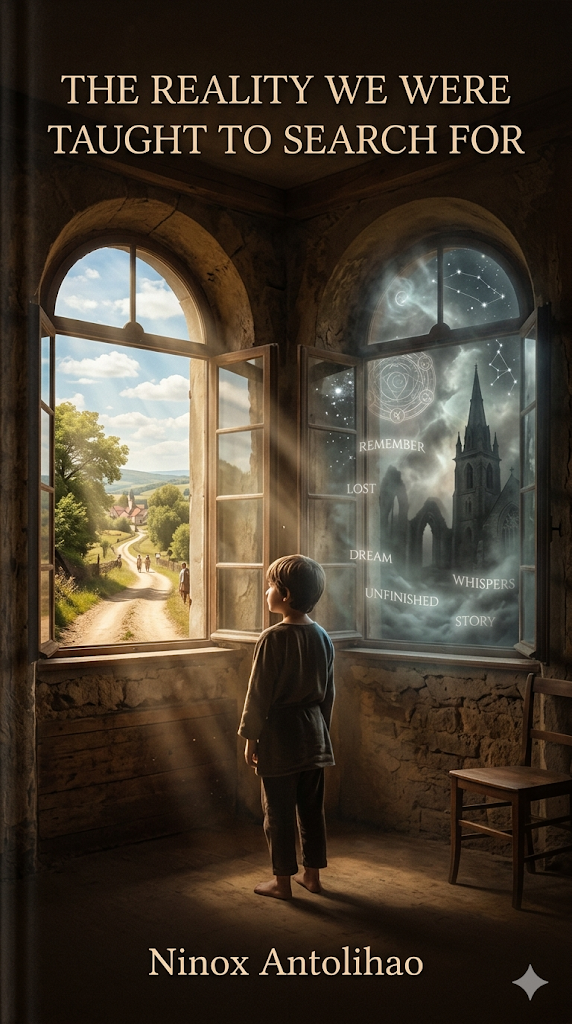
I began by asking what reality means.
At first, reality seemed like something simple. Reality is what exists. Reality is what happens. Reality is what we live through. But the deeper I looked, the more I realized that the word itself is not as simple as it appears. People use the word reality as if it is one solid thing, but every person experiences reality through a different mind. What one person calls truth, another may call interpretation. What one person calls purpose, another may call conditioning. What one person calls spiritual hunger, another may see as an old memory asking to be understood.
This led me to a clearer separation.
There is the physical world — the world of body, matter, consequence, pain, hunger, death, action, evidence, and results. This is the world that pushes back. If we touch fire, it burns. If a customer waits too long, the delay has consequences. If a system fails, the failure appears in real life. The physical world does not need our belief to affect us.
Then there is the inner world — the world of thought, imagination, fear, hope, memory, belief, meaning, guilt, dreams, and interpretation. This world is also real, but real in a different way. A fear may be real inside the person, even if the danger is not outside. A belief may feel powerful, even if it has not been proven. A dream may affect someone deeply, even if it did not happen in the physical world.
This is where confusion begins. We often force two different worlds into one. We take imagination and demand that the physical world obey it. We take belief and call it reality. We take expectation and mistake it for truth. But expectation is not reality. Imagination is not reality. Reality is lived. Reality is what life confirms.
Expectation is the picture inside the mind. Reality is what happens when life answers back.
The familiar idea of “expectations versus reality” explains this better than many complicated teachings. Expectation is the image we hold before life responds. Reality is the result that appears after the image is tested. The gap between the two exposes the difference between what we imagined and what actually holds.
This made me question how religion uses the word reality. Religion often speaks of another reality — heaven, hell, soul, divine plan, spiritual battle, unseen purpose. It may call these things “true reality,” sometimes even more real than the world we live in. But if something cannot yet be experienced, tested, verified, or honestly understood, should it already be called reality? Or should it be called possibility, belief, mystery, claim, or imagination?
This does not mean another world cannot exist. It only means we should be careful with the word reality. To call something reality is to give it authority. And when an institution controls what people are allowed to call reality, it also controls how people think, obey, fear, and judge themselves.
Maybe spiritual reality exists. Maybe there is something beyond the physical world. But as of now, what I clearly recognize are two forms of reality: the physical reality we live through, and the inner reality we experience through the mind. What people call spiritual may sometimes be a deeper layer of the inner world — the part that deals with meaning, conscience, longing, guilt, purpose, and transformation.
But then another thought appeared.
What if some of what we call spiritual longing is not actually a discovery of something beyond us, but the return of something planted in us before we could understand it?
A child hears many things before the child can process them. The child hears about God, heaven, hell, soul, sin, purpose, destiny, judgment, obedience, and divine plan. The child may not understand these ideas, but the words enter deeply. They attach themselves to fear, love, family, belonging, guilt, and safety. They become emotional seeds before they become clear thoughts.
Later, when the person grows older and becomes capable of deeper thinking, a strange longing appears. Something feels missing. Something feels unfinished. The person begins to search. Religion may say, “That is your soul searching for God.” Others may say, “That is your purpose calling you.” But maybe, in some cases, the mind is not searching for a missing spiritual object. Maybe it is trying to complete information planted in childhood before understanding was possible.
What was heard before reason may later return as longing.
An idea planted before awareness can disguise itself as destiny.
This does not make the longing fake. The longing is real as an experience. But its origin may not be what we were told. It may not always be proof that something divine is calling us. It may be the unfinished child inside us trying to understand the words that were placed there too early.
That is why early teachings are powerful. They do not only become beliefs. They become emotional architecture. They shape what feels missing, what feels sacred, what feels dangerous, and what feels forbidden to question.
Maybe the search for meaning is not always a search for truth outside us. Sometimes it is the mind returning to an old room inside us, looking for the first voice that told us we were incomplete.
This reflection changed the way I understand reality. I no longer want to accept reality just because someone names it reality. I want to ask: Is it lived? Is it tested? Is it shared? Is it verified? Is it only imagined? Is it inherited? Was it chosen freely, or was it planted before I had the ability to question?
Reality should not depend only on authority. Reality should not be protected from questions. Reality should not be used to control the mind.
A belief may comfort us. A myth may guide us. A spiritual story may give meaning. But none of these should be forced to replace lived reality.
In the end, I am not rejecting mystery. I am rejecting the habit of calling mystery a certainty.
There may be more than what I know. But I must be honest about what I know, what I only imagine, what I inherited, and what I have truly lived.
Perhaps wisdom begins there — not in claiming full reality, but in learning which part of reality we are actually touching.
Reality is lived.
Imagination is not reality.
Belief is not proof.
Meaning is not automatically truth.
And sometimes, what we call purpose may only be the echo of a childhood idea still waiting to be understood.
— Ninox Antolihao
Comments